
June 25, 2026
June 25, 2026
We are thrilled to announce Vienna Lepple as one of our 2026 Dakota Prep Fellows! Currently an electrical apprentice at Niagara College, Vienna embodies the curiosity, leadership, and community-building spirit that the Dakota Prep Fellowship celebrates. Selected from a field of more than 50 applicants in the program's second year, Vienna stood out for a decision that says a great deal about where real value is being created in today's economy: she traded an engineering degree for a tool belt, and hasn't looked back.
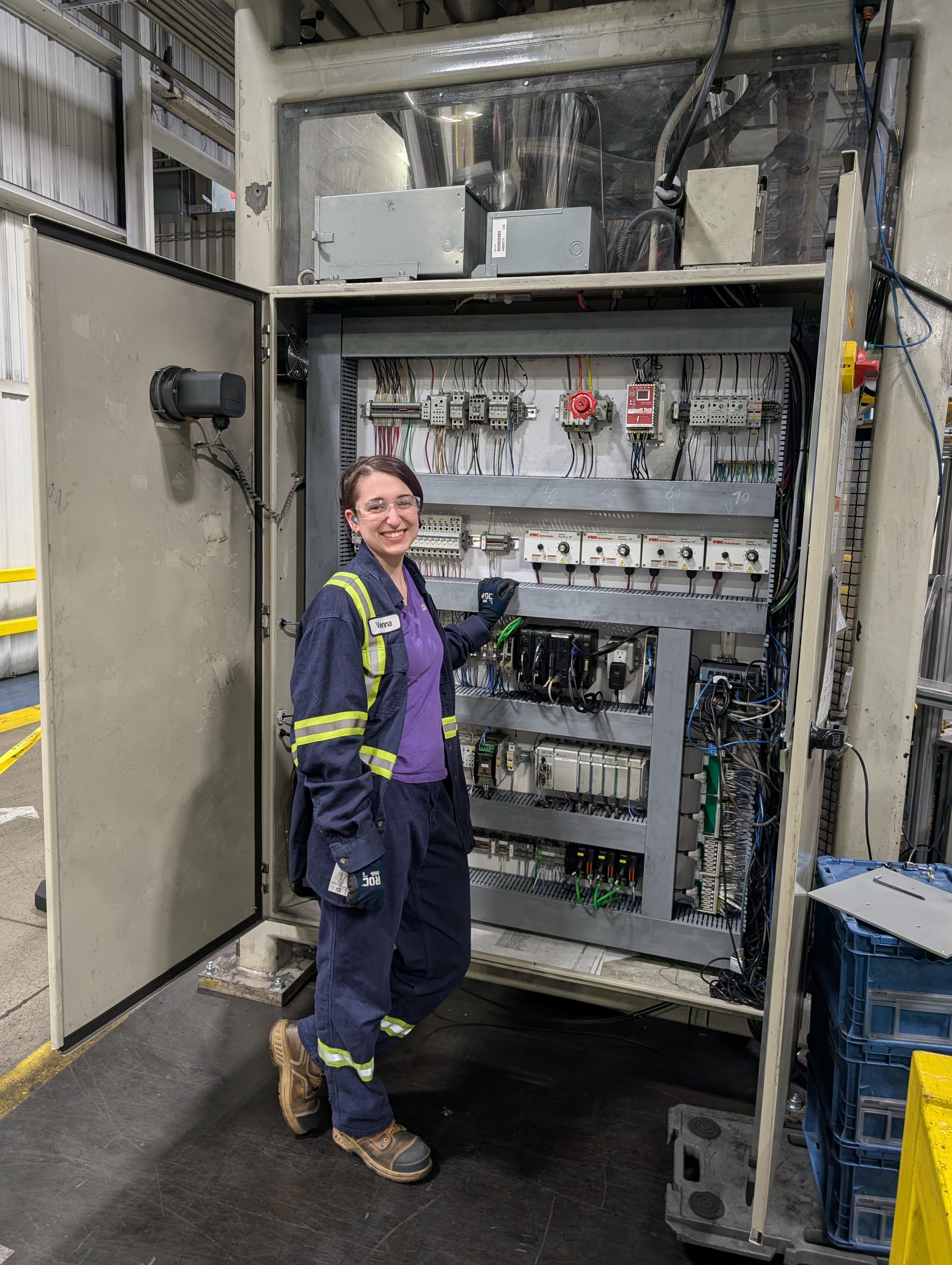
Vienna's path into the electrical trade reads less like a straight line and more like a deliberate leap, and a telling one. For years, the conventional wisdom has pushed talented students toward a four-year engineering degree as the obvious "smart" choice. Vienna did exactly that, completing an automation engineering degree at McMaster University after being steered toward it by family. Then she did the thing almost no one expects: she pursued a skilled trade instead.
It wasn't a step down. It was a read on the market. As automation reshapes manufacturing and the push toward electrification and renewable energy accelerates, the people who can actually build, wire, and commission these systems are in critically short supply, and increasingly, they are the ones holding the leverage. Vienna saw that the hands-on electrical work happening on the shop floor wasn't a fallback from engineering; in a labor market starved for skilled tradespeople, it may well be the more valuable, more secure, and more future-proof career.
The passion took root well before graduation. On a co-op placement during her engineering program, an employer asked Vienna which department she was most interested in. Her answer was telling: all of it. She wanted to experience the entire process of building automation machines, not just the design side, and she ended up spending more than half of that placement on the shop floor with the electrical department, working alongside electrician apprentices.
"I got to see how important the trades were, and how passionate I felt about working within them. From then on I knew that I wanted to get my ticket and be an electrician."
What she loved most wasn't designing systems in the abstract. It was building them, wiring them, and watching them come to life.
Vienna now works for a company that builds automation lines for manufacturing plants. While her role isn't an engineering one, her engineering background gives her a rare dual fluency: she understands why a system was designed a certain way, and she can speak the language of the designers on her team.
That fluency has become one of her most valuable contributions. Vienna actively works to close the gap between the people who design machines and the people who build them. She encourages designers to get hands-on, even wiring practice panels themselves, so they understand realities like installation timelines, component limitations such as inrush current, and the difference between a machine on paper and a machine on the floor.
"I hope I will be able to utilize my engineering degree to bridge the gap between the two departments."
Helping peers has been a constant across all three terms of trade school. Classmates naturally gravitated to Vienna for guidance: she has commandeered empty classrooms to work through math theory on the whiteboard, sat with students in the library to teach them how to use a breadboard most had never seen in the field, and helped turn the cafeteria into a standing spot where students gather to tackle their toughest course questions together.
This term, the subject most students struggle with is PLC code, specifically logic diagrams and the distinction between Normally Open (XIC) and Normally Closed (XIO) contacts, a concept that trips up many apprentices because computer logic doesn't always match physical reality. Vienna leads group discussions on it and sits down one on one with students who need extra help, often using a walkie-talkie analogy to separate what's physically happening in a circuit from what the controller "thinks" is happening. During labs, she stays behind even after she's finished, because she wants every student to get the chance to learn the material and succeed.
"I enjoy explaining concepts in multiple ways, but most of all I love seeing when the explanation works with their learning style. You can see the puzzle pieces fit together and their faces light up with understanding."
Her proudest achievement in trade school is mentoring one specific classmate who came from a niche domain with no exposure to the material. The classmate showed a relentless willingness to learn, Vienna put in extra effort to guide her through the hardest subjects, and over three terms Vienna watched her grow. It's exactly the kind of patient, peer-to-peer teaching the Dakota Prep Fellowship was created to recognize.
Vienna's pivot challenges a stubborn assumption: that a university degree automatically outranks a trade certification. When she chose an electrical apprenticeship after finishing engineering, peers and even some university professors were surprised, a reaction rooted in the old idea that engineering is inherently more prestigious than the work that happens on the floor.
Her own experience tells a different story. Niagara College's program offered far more depth in both theory and practical application than she expected, taught by instructors who were knowledgeable, passionate, and proud of their craft. And the economics back her up: while a glut of degree-holders compete for a finite number of office roles, the demand for skilled electrical tradespeople keeps climbing, with the earning potential, job security, and career mobility to match. Tradespeople, she points out, are the backbone of the industry, and that backbone has never been more valuable than it is right now.
For Vienna, the appeal isn't only the demand. It's that the learning never ends.
"I want to continue to become a good electrician in my field and keep learning even if I am licensed, since you can always improve."
Vienna's story makes one thing clear: the "safe" credentialed path and the "valuable" one are no longer the same thing. Her willingness to leave a conventional white-collar track for a tool belt shows students, especially those who assume a degree is the only smart bet, that hands-on electrical work can be just as intellectually demanding, far more in demand, and ultimately more rewarding. In an economy reshaped by automation and electrification, the skilled trades aren't where careers go to settle; they're where the next generation of opportunity is being built.
Now on the final school term of her apprenticeship, Vienna is looking ahead to writing her Certificate of Qualification, and to a longer-term ambition: once she's logged real time on the floor, her dream is to become a teacher for the apprenticeship program. The Dakota Prep Fellowship will support her as she continues mentoring her classmates, bridging the gap between design and the trades, and helping shape stronger industrial-controls learning for the apprentices who come after her.
"At the end of the day, even if I want to help others, only they can put in the effort to better themselves. All I can provide them is the chance to do exactly that."
Download now to access thousands of practice questions across electrical & plumbing for US and Canada