
April 30, 2026
Thermal Expansion in Closed Potable Systems
Plumbing Study Guide
April 30, 2026
Plumbing Study Guide
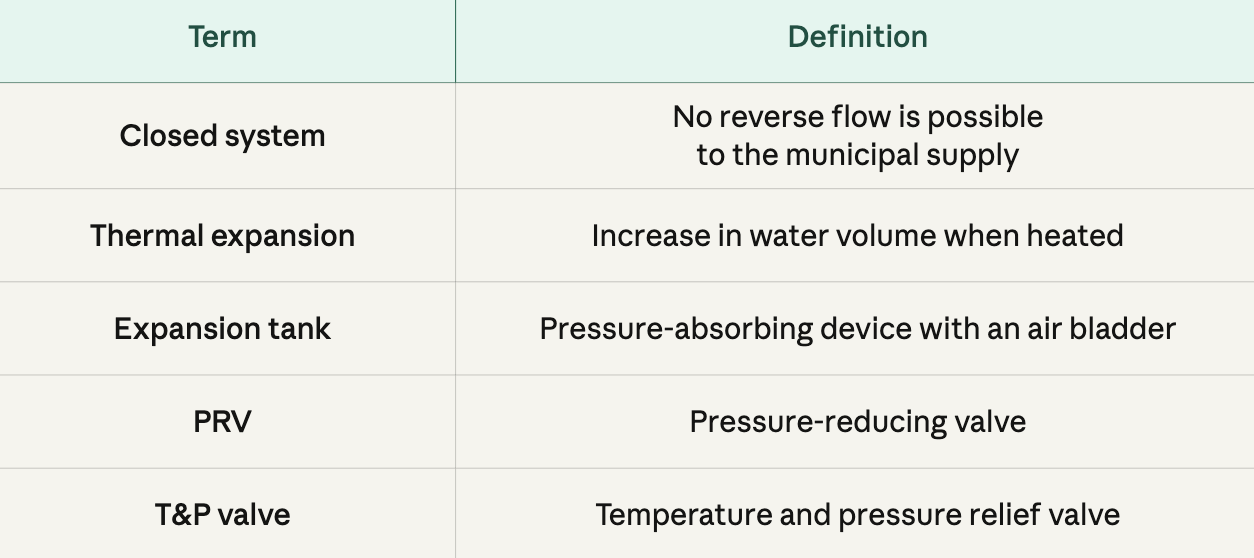
When water is heated, it expands in volume. In an open system, expansion pushes back into the municipal main. In a closed system, a device such as a backflow preventer, check valve, or pressure-reducing valve (PRV) prevents backflow, so heated water has nowhere to go.
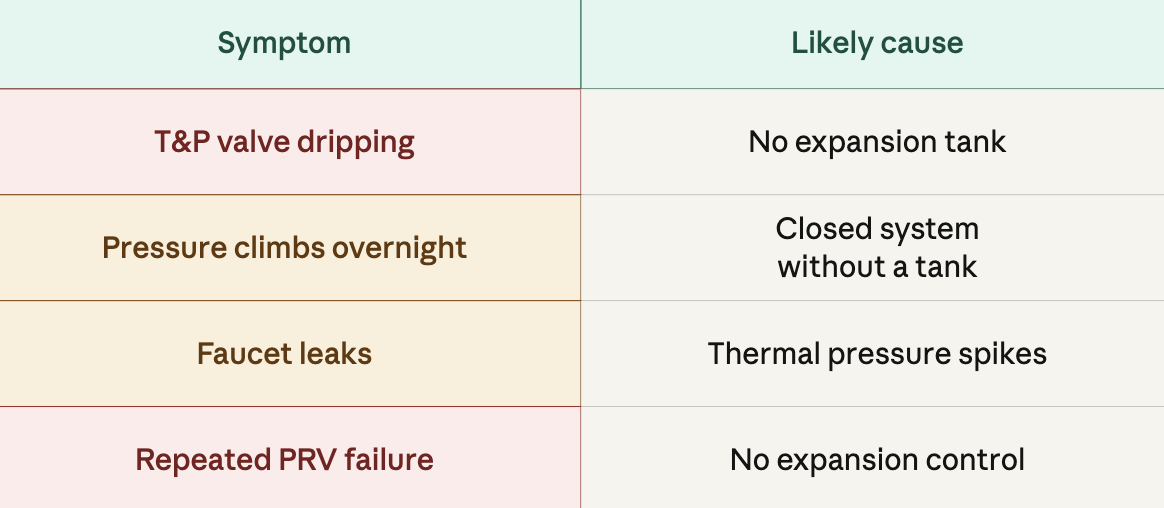
Result: Pressure spikes, T&P valve discharge, fixture leaks, pipe stress, and premature equipment failure.
A system becomes “closed” when a device prevents reverse flow into the municipal supply. Under the NPC, potable systems must be protected from backflow (Section 2.6). Once backflow protection is installed, the system is hydraulically closed, which necessitates expansion control.
While the NPC does not use the phrase “thermal expansion tank” directly, it establishes the need for pressure control and protection through:
NPC 2.6 – Protection from Contamination
Backflow preventers and check valves create closed systems.
NPC 2.6.1.14 – Water Hammer & Pressure Control
Requires systems to prevent excessive pressure conditions.
NPC 2.2.6 – Protection from Excessive Pressure
Water distribution systems must be protected where pressure exceeds safe limits.
NPC 2.6.2 – Backflow Prevention
Installation of backflow devices results in a closed system — expansion must then be controlled.
If you install a backflow device or PRV, you must account for pressure rise.
Water expands approximately 1.7% in volume when heated from 10°C to 60°C. In a 50-gallon (190 L) water heater, that equals ~3.2 litres of expansion. If that volume cannot move backward into the main, pressure can exceed 150 psi (1035 kPa), causing T&P relief valve dripping, fixture failure, and pipe joint stress.
Expansion Tank (Most Common)
A potable thermal expansion tank contains an air bladder (pre-charged) separated from water by a diaphragm, housed in a steel tank body.
How It Works:
Water heats and expands → expanded water flows into the tank → air compresses → pressure is stabilized.
Installed:
Pressure Relief Valve (Not Primary Control)
The T&P valve on a water heater opens at 150 psi or 99°C. It is a safety device — not meant for routine expansion control. Frequent discharge indicates expansion problems.
Step 1 – Determine System Conditions
Step 2 – Estimate Expansion Volume
Expansion Volume = Tank Volume × 0.017
Example: 190 L heater × 0.017 = 3.2 L expansion
Step 3 – Select Expansion Tank
The tank must handle the expansion volume, be rated for system pressure, and be pre-charged to match the static pressure.
Example: If static pressure = 60 psi, pre-charge the tank to 60 psi before installation.
While the NPC does not list a prescriptive tank location rule, compliance requires the tank to be:
When a PRV is installed, it reduces pressure entering the building, acts like a check valve, and creates a closed system. Therefore, installing a PRV always requires installing a thermal expansion tank.
Typical lifespan: 5–10 years, depending on quality and pressure conditions.
Hot Water Tank Heating Water
When cold water enters a hot water tank, it gets heated — typically from around 10°C up to 60°C. As the water warms up, it expands. Simple enough, but in a closed system, it becomes a problem.
If there's a check valve or backflow preventer on the supply line, the expanding water has nowhere to go. It can't push back into the municipal main, so instead, the pressure builds inside the system.
The fix is straightforward — a thermal expansion tank installed on the cold water line gives that extra volume somewhere to go, keeping the pressure under control.
A house has a pressure-reducing valve (PRV) installed on the water service. A storage-type hot water heater is installed downstream of the PRV. After installation, the temperature and pressure relief valve on the water heater begins to discharge water when the heater operates.
According to the National Plumbing Code, what is the most likely cause and required correction?
A. The relief valve is defective and must be replaced
B. The system pressure is too low, and a booster pump is required
C. Thermal expansion is occurring in a closed system, and an expansion tank must be installed
D. The water heater is undersized and must be replaced
Correct Answer
C — Thermal expansion is occurring in a closed system, and an expansion tank must be installed
1. PRV creates a closed system
Under the National Plumbing Code
2.6.1.12. Protection from Thermal Expansion
Where a check valve, backflow preventer, pressure-reducing valve, or other device creates a closed system, a means shall be provided to control pressure caused by thermal expansion.
A PRV is installed
PRV prevents water from expanding back into the main
The system is now closed
Therefore → expansion control is required.
2. Why is the relief valve discharging
When the heater runs:
This is a classic exam scenario.
3. Required correction
NPC requires a device to control expansion, such as:
Typical installation:
Expansion tank on the cold water supply to the heater
4. Why are other answers wrong
A — Replace the relief valve
Valve is doing its job.
B — Booster pump
Not related to expansion
D — Heater undersized
Size does not cause a pressure rise.
When you install a backflow preventer, check valve, or pressure-reducing valve, you have likely created a closed potable system. Under Canada’s National Plumbing Code, systems must be protected from contamination and excessive pressure. Thermal expansion control — typically via a properly sized expansion tank — is required to maintain safe operating pressure and prevent system damage.
Download now to access 500+ practice questions and master the Red Seal Plumbing!