
Quadratics: Standard Form, Roots & Solving Methods
Study Guide
Study Guide
Quadratics are equations or expressions where the highest power of x is 2 (x² = x squared). They are called quadratics from the latin word for square, quad. They can also be referred to as trinomials.
Quadratics are written in the form
ax² + bx + c = 0
where a and b are the coefficients multiplied to x and c is the constant. They are placeholders for numbers that can be whole numbers or fractions, positive or negative.
Our job? Find the values of x that make the equation true. These are called the solutions or roots.
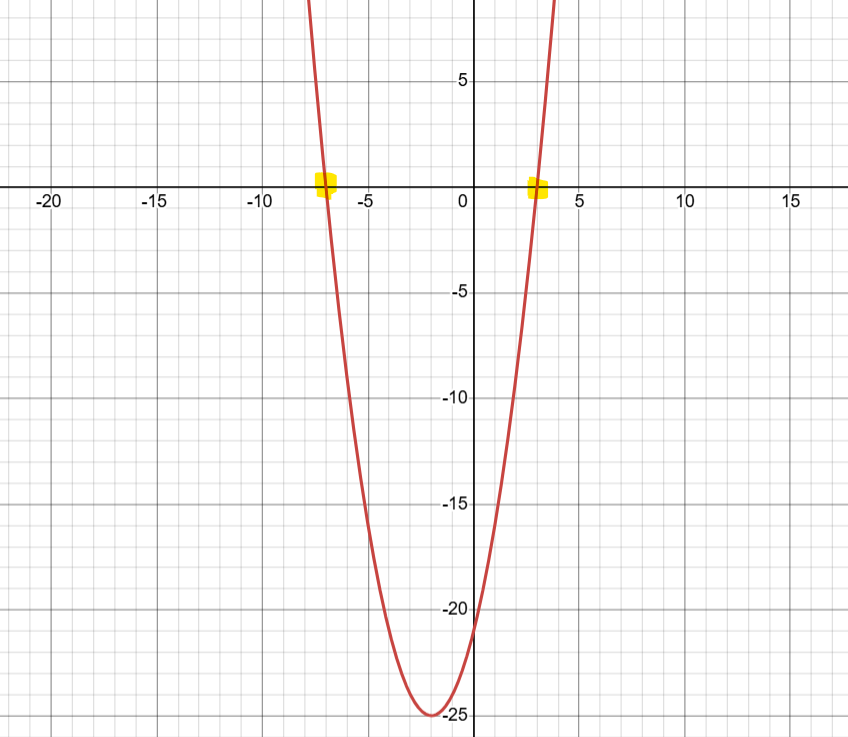
On a graph, a quadratic equation takes a U-shape, called a parabola. If the quadratic is equal to zero, such as x²+4x-21 = 0, the solutions are the x-values when y is equal to zero. In other words, it is where the graph crosses the x-axis.
Here is the graph for x²+4x-21 = 0. The solutions for this equation are highlighted in yellow below. They are the two points where y=0. The points are x=3 and x=-7.
Factoring is the easiest first approach, and the others are available in case it cannot be easily factored. Check out this video for a visual tutorial on factoring trinomials (quadratics)
Reminder: a quadratic is in the form ax²+bx+c. The a, b and c can be positive or negative, whole or fraction numbers.
In this case, the coefficient on x² is 1, or a=1. This means we can likely factor it using the following strategy:
The constant is the product of the factors that add to the middle coefficient. In other words, the last term is the product of the factors and the middle term coefficient is the sum of the factors.
Step 1: Look for factors of 15 that add to 8. This means, find two numbers that multiply to 15 that add to 8. We can make a factor table to see which factors multiply to 15 and add to 8.

The two factors that add to 8 are 3 and 5.
Step 2: Write out the factors in brackets with x.
(x + 3)(x + 5) = 0
We can check this by multiplying the terms to see if it equals our first equation.
X² + 3x + 5x + 15 which simplifies to x² + 8x + 15
Step 3: Solve each factor by setting each bracket = 0 and isolate for x using algebra.
x + 3 = 0 →subtract 3 from both sides to isolate x → x = –3
x + 5 = 0 →subtract 5 from both sides to isolate x → x = –5
Therefore, the solutions are: x = –3 and x = –5
This video is another example on factoring trinomials:
Reminder: a quadratic is in the form ax²+bx+c. The a, b and c can be positive or negative, whole or fraction numbers.
Since the first coefficient, a, is not 1 this time, we can use the completing the square method or the quadratic formula method. This is a walkthrough of completing the square and factoring by grouping:
Step 1: Multiply a × c.
Here, a = 3, b = –10, c = –8.
Multiply a × c = 3 × –8 = –24.
Step 2: Find two numbers that multiply to –24 and add to –10.
Those are –12 and +2.
Step 3: Split the middle term.
3x² – 12x + 2x – 8 = 0
Step 4: Factor by grouping. The greatest common factor is the binomial (x-4) which can be factored out of the equation. Group the remaining terms.
3x(x – 4) + 2(x – 4) = 0
(3x + 2)(x – 4) = 0
Step 5: Solve each factor by equating each of the brackets to zero and isolate for x using algebra.
3x + 2 = 0 → subtract 2 and divide by 3 on both sides → x = –2/3
x – 4 = 0 →add 4 on both sides → x = 4
Solutions: x = 4 and x = –⅔
Here is a video tutorial on another helpful method to solve these complex quadratics:
Step 1: Multiply a × c.
a = 6, c = –12 → a × c = –72
Step 2: Find two numbers that multiply to –72 and add to –1.
Those are –9 and +8
Step 3: Split the middle term.
6x² – 9x + 8x – 12 = 0
Step 4: Factor by grouping. The greatest common factor is the binomial (2x-3) which can be factored out of the equation. Group the remaining terms.
3x(2x – 3) + 4(2x – 3) = 0
(3x + 4)(2x – 3) = 0
Step 5: Solve each factor by equating each of the brackets to zero and isolate for x using algebra.
3x + 4 = 0 →subtract 4 and divide by 3 on both sides → x = –4/3
2x – 3 = 0 →add 3 and divide by 2 on both sides → x = 3/2
Solutions: x = –4/3 or x = 3/2
Try these (factor where possible):
Factors of 10 that add to -7 are -5 and -2.
Factor
(x-5)(x-2)=0
Set each bracket to equal zero
x-5=0 → isolate x → x=5
x-2=0 → isolate x → x=2
Solution: x = 5 and x = 2
Multiply 2 and -3 = -6.
Find two numbers that multiply to -6 and add to 5
-1 and 6
Split the middle term
2x² -1x + 6x – 3 = 0
Factor by grouping
x(2x-1)-3(2x-1) notice that we factor out -3 such that the terms inside the brackets are the same
Factor out the GCF (2x-1) and collect the remaining terms
(2x-1)(x-3)=0
Solve for x by equating each factor to 0
2x-1=0 → isolate x → x =1/2
x-3=0 → isolate x → x=3
The solutions are x = 3 and x=1/2
This is a special property called a perfect square trinomial. A perfect square trinomial follows the identity (or pattern) of p² + 2pq + q² where the first and last terms are square terms and the middle is 2 times the sum of the first and last term without the squaring.
In this case the first term is x², the last term is 3² and the middle term is 2 x 3
Or (x)²+2(x)(3)+(3)²
When this is the case, we can factor it as (p+q)(p+q) or (p+q)²
For this example, this would look like (x+3)(x+3)=0 or (x+3)²=0
This means there is only one solution since the two factors are identical. If we set the factors to zero, we find:
x+3=0 → isolate x → x = -3
This is also a perfect square trinomial. It can be rewritten as
(2x)² - 12x + 3² =0 or (2x)² -(2)(2x)(3)+(3)² which follows the identity p² - 2pq + q². Notice that this time, the second term is subtracted. This means it can be factored as (p-q)(p-q) or (p-q)².
In this example, we can write our factors as:
(2x-3)(2x-3) or (2x-3)²
(2x-3)²=0
Solve for x by setting the bracket to zero and isolating for x
2x-3=0
x=3/2
Solution: x = 3/2
Download now to access 600+ practice questions for free and our algebra AI tutor!