
Whether you're preparing for your first electrical licensing exam or refreshing your knowledge of the code, this glossary provides clear, plain-English definitions of terms you'll encounter while studying with Dakota Prep.
It covers the exams electricians pursue, such as Journeyman, Master, and Contractor tests, along with the National Electrical Code editions that shape them.
You'll also find explanations of study tools and methods, including the AI tutor, practice exams, and practice modes. Each definition is written to be quick to read and easy to understand.
In this glossary, you'll learn:
In a wye system, the line-to-line voltage is the phase voltage multiplied by √3. This comes from the geometry of three vectors 120° apart. If phase-to-neutral is 120V, line-to-line is 120 × 1.732 = 208V.
A 90° bend formed in EMT (electrical metallic tubing) using a hand bender. Place the bender's arrow at your mark, set your foot on the footrest, and pull the handle up while keeping steady downward pressure so the tube follows the die. The goal is a smooth, square 90° with no kinks, flattening, or wrinkles that would restrict wire pulling.
A common commercial voltage produced by a three-phase wye system in which each phase measures 120V to neutral. Because the three phases are 120° apart, the voltage measured between any two of them is 120 × 1.732 (√3) = 208V. This gives a building both 120V for receptacles and lighting and 208V for larger single- and three-phase equipment.
A higher-voltage three-phase system measuring 480V between phases and 277V from each phase to neutral in a wye configuration. It is the standard for commercial and industrial power because higher voltage delivers the same power at lower current, allowing smaller conductors and less voltage drop. The 277V phase-to-neutral leg is widely used for commercial fluorescent and LED lighting.
AC (alternating current) runs at 60 cycles per second in North America, which means it reverses direction 120 times per second. DC (direct current) flows in one direction only. AC is used for power distribution because it can be transformed to different voltages easily. Batteries and electronics run on DC.
An Arc Fault Circuit Interrupter detects the electrical signature of arcing, caused by damaged wire insulation, loose connections, or staples through cables. Regular breakers can't detect these; they only trip on sustained overcurrent, by which point a fire may have already started.
An interactive, 24/7 learning tool designed to help users pass trades examinations, particularly electrical licensing exams. It mimics a live instructor by guiding students through complex trade concepts, breaking down difficult topics step-by-step rather than just providing answers.
Aluminum is much less expensive and lighter than copper. At large sizes (1/0 and above), the cost difference is significant. The tradeoff is that aluminum requires larger conductors for the same ampacity and needs antioxidant compounds on connections.
The maximum current, in amps, that a conductor can carry continuously without its temperature rising above the rating of its insulation. Ampacity depends on the conductor's size and material, its insulation type, and conditions like ambient temperature and how many conductors are bundled together. Exceed it and the insulation breaks down, creating a shock and fire hazard.
Aluminum oxidizes when exposed to air, forming a layer of aluminum oxide which is a poor conductor. Antioxidant paste inhibits this oxidation and helps maintain a good electrical connection.
An electrical apprentice who learns to install, maintain, and repair electrical systems under the direct supervision of a licensed journeyman or master electrician. The core duties include assisting with installations, reading blueprints, maintaining safety, and helping diagnose electrical issues under supervision.
A standardized entrance exam that’s required for most IBEW/NECA electrical apprenticeship programs. Its primary purpose is to evaluate if you have the foundational math and reading skills necessary to handle the technical classroom instruction you will face as an apprentice.
An arc flash is a violent release of energy from an electrical arc, it produces a fireball of superheated plasma, intense light, pressure waves, and molten metal. It can cause severe burns or death even without direct contact.
Used to correct power factors where high inductive loads are present. Capacitors provide reactive power locally, reducing the reactive current that has to flow from the utility, which reduces losses and can lower utility demand charges.
A single-phase motor that uses a capacitor in series with a start winding to create the phase shift needed to produce a starting torque. The capacitor and start winding are disconnected by a centrifugal switch once the motor reaches running speed.
The main factors that reduce voltage along a circuit: long wire runs, undersized conductors, heavy current loads, or loose and corroded (high-resistance) connections. Each adds resistance that consumes voltage before it reaches the equipment. The usual fixes are increasing the conductor size, shortening the run, or repairing poor connections so the load receives its full rated voltage.
A chronological record of all notable changes, fixes, and feature additions made to a software project or digital product.
It's an automatic switch that opens (trips) when current exceeds its rating, protecting the wiring from overheating. It protects the wire, not the equipment. Reset manually after the cause is corrected.
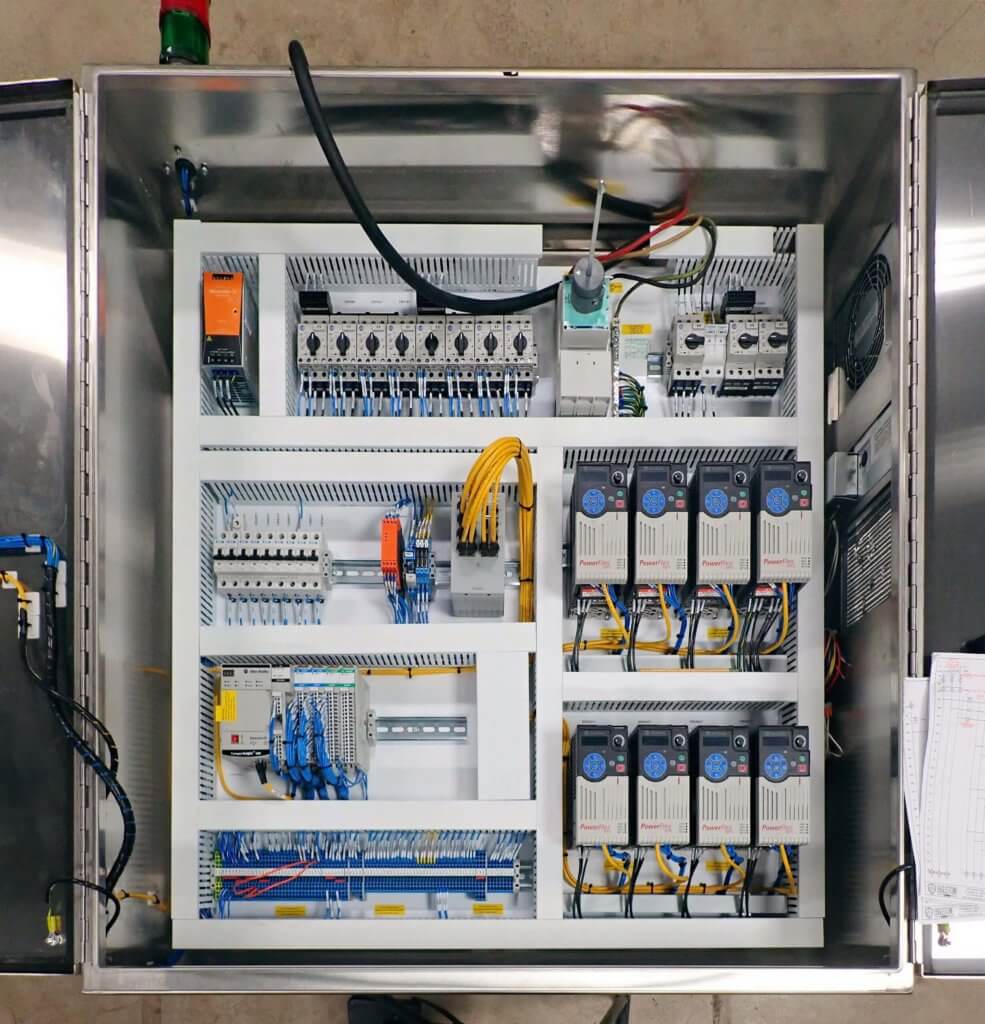
Clearly identifying every breaker and circuit in a panel so each one can be matched to the equipment it feeds. Good labeling lets the right circuit be de-energized for maintenance without shutting off others by mistake, and lets anyone working on the system understand it quickly. Missing or inaccurate labels are a real safety hazard.
A clamp meter measures current by clamping around a single conductor. The changing magnetic field from current flow is detected without breaking the circuit. Use it to check motor current, verify circuit loading, or troubleshoot imbalances.
A specific citation, section number, or table identifier pointing directly to an official set of regulations, laws, or technical standards. It’s used to guide test-takers through National Electrical Code (NEC) and National Plumbing Code (NPC) explanations.
A series of concentric rings in an electrical enclosure that can be removed to create different hole sizes, without a knockout punch, by using a hammer and screwdriver to knock out the rings.
When multiple current-carrying conductors are bundled together, they generate heat that can't dissipate as easily. We derate (reduce) the allowable ampacity to prevent insulation damage.
The maximum temperature the insulation can withstand without degrading. Using a conductor in an environment hotter than its rating will break down the insulation, creating a shock and fire hazard.
Unsupported conduit can sag, stress fittings, and pull connections loose. Unsupported cable can be physically damaged. Support spacing requirements ensure the installation remains stable long-term.
A hand tool used to bend conduit. Has an arrow, star, and degree markings. The arrow is used for stub-up bends (mark where the end of the 90 will be), the star is used for back-to-back bends.
A fitting that provides access to conductors in a conduit run for pulling and splicing. Common types: LB (90° with cover at the back), LL (left 90°), LR (right 90°), C (straight through), T (tee).
An electrical code requirement, and common exam topic, that limits the maximum percentage of a conduit's interior cross-sectional area that its conductors may occupy. Keeping within the fill limit leaves room to pull wire without damaging insulation and lets the conductors shed heat. Overfilling makes pulling difficult or impossible and causes conductors to run hot because they can't dissipate heat properly.
The path from one pull point to another, including all the conduit sections, fittings, and bends in between. Planned before installation to minimize bends and make wire pulling as easy as possible.
Code requirements for how often conduit must be fastened and supported along its run and near boxes. For EMT, the conduit must be secured within 3 feet of every box, fitting, or enclosure and supported at least every 10 feet along the run. Exact spacing varies by conduit type and size, but the goal is always a stable, well-anchored installation.
Continuity testing checks if a complete path exists between two points. A continuous path (low resistance) means the conductor is unbroken. Open circuit means the path is broken somewhere.
An independent individual or business entity hired by a client to perform specific work, provide services, or deliver materials under a legally binding contract. Unlike a traditional employee, a contractor manages their own operations, sets their own schedule, provides their own tools, and is responsible for paying their own taxes.
The flow of electrons through a conductor, measured in amps (A). In the common water analogy, current is the flow rate of water moving through a pipe. It is driven by voltage and opposed by resistance, and it is the quantity that actually does work in a circuit, heating elements, spinning motors, and lighting lamps.
The relationship described by Ohm's Law: when voltage is held constant, current falls as resistance rises. More resistance restricts the flow of electrons the same way a narrower pipe restricts water flow. Doubling the resistance halves the current; halving the resistance doubles it. This inverse relationship is fundamental to sizing circuits and diagnosing faults.
A fuse that clears a fault so quickly it limits the let-through current. Used in high fault-current applications where the let-through current could damage equipment even before a regular breaker opens.
The primary is connected in a delta (triangle) configuration and the secondary in a wye (star). This is the most common utility and commercial transformer configuration because it provides a neutral on the secondary for 120V loads while blocking some harmonics.
A utility billing charge based on the peak power demand during a billing period, not just total energy used. A brief high demand event can significantly increase a bill. Industrial facilities manage this carefully.
Reducing the allowable ampacity of a conductor when conditions cause excess heat, such as high ambient temperature, conduit fill with multiple conductors, or installing in a hot location. Look up the correction factors in the ampacity tables.
A dimmer reduces voltage to a light to reduce brightness. Must be matched to the load type, incandescent dimmers don't work on LED or fluorescent fixtures. Use LED-compatible dimmers for LED lighting.
A switch that de-energizes equipment so it can be safely worked on. Motors and equipment must have a disconnecting means within sight of the equipment. Some are fusible (contain fuses) for additional protection.
Check for electrical, plumbing, and structural elements with a stud finder, wire tracer, and inspection. Drilling through a live wire creates a shock hazard and a potential fire.
A deliberate downward loop left in overhead service conductors just below the point where they attach at the weatherhead, before they turn and rise into the conduit. Water running down the wires collects at the bottom of the loop and drips off, instead of following the conductors up and into the service entrance. It is a simple but required detail on overhead services.
A transformer cooled by air circulation rather than oil. Common in buildings because they don't pose a fire or spill risk. The core and windings are exposed to air.
Has two elements: one that blows instantly on short circuits and one that delays on moderate overcurrents. Allows motor inrush to pass without blowing while still protecting against overloads and faults.
A mandatory, jurisdiction-specific test assessing an applicant's technical knowledge, safety compliance, and business practices before licensing them to run an independent electrical contracting business.
A safety mechanism that prevents two things from happening simultaneously, like two sources from being connected at the same time, or a motor from running without a safety guard in place.
The EGC is the green or bare (typically copper) wire in a circuit. It connects metal parts of equipment back to the panel so that if a live wire touches metal, fault current flows back and quickly trips the breaker instead of energizing the enclosure and shocking someone.
Connecting all metal surfaces in an area so they're all at the same voltage. Critical in wet areas like pools and bathrooms where contact with multiple surfaces is likely. Prevents voltage differences from causing shock.
De-energize the circuit. Use an ohmmeter between hot and neutral (or ground). A reading close to zero ohms confirms a short. Then isolate sections of the circuit to narrow down the location.
Use a voltmeter. Start at the panel where you have voltage. Work downstream, testing at each point. The point where voltage disappears is beyond the break. Or use a continuity tester on a de-energized circuit to find the open.
A stiff flat metal or fiberglass tape coiled in a reel, used to route through walls, conduit, or ceiling spaces to pull wire. Sent through first, then wire is attached to the hook on the end and pulled back.
Usually a loose connection somewhere, at the fixture, switch, outlet, or panel. Could also be a utility problem (transformer issue) or an overloaded circuit causing voltage drop. Investigate by checking all connections in the circuit.
A neutral that's lost its connection to ground, causing the neutral point to shift. In a 3-phase system, this causes voltage unbalance across phases. Dangerous and must be repaired immediately.
Used to control a light from three or more locations. Goes between two three-way switches. It has four terminals and swaps the traveler connections each time it's toggled.
A fused disconnect contains fuses for overcurrent protection. An unfused disconnect simply breaks the circuit. Fused disconnects are common on motors and equipment where overcurrent protection is needed.
A transfer switch disconnects the building from utility power before connecting the generator. Without one, backfeed from the generator can energize the utility lines and electrocute utility workers.
A Ground Fault Circuit Interrupter monitors the difference in current between hot and neutral. If more than ~5 milliamps flows where it shouldn't (a ground fault path), it trips before the current can cause electrocution, clearing in as little as 1/40th of a second at high fault currents.
Two ways to provide ground-fault protection. A GFCI receptacle protects only itself and any standard outlets wired downstream of it, so one device can cover several locations. A GFCI breaker installs in the panel and protects every outlet and device on that entire circuit. Receptacles are cheaper per location; a breaker is simpler when the whole circuit needs protection.
A common name for Flexible Metal Conduit (FMC), a spiral-wound metal tube supplied without conductors inside. Its flexibility makes it ideal for the final connection to motors, transformers, and other equipment that vibrates or needs to move, since it absorbs movement that rigid conduit would transmit. It is used in dry locations; a liquidtight version (LFMC) is used where moisture is present.
When a hot conductor contacts a grounded metal surface or the earth, current takes an unintended path back to its source. This can energize equipment enclosures and create a shock or fire hazard.
A conductive object embedded in the earth that provides the connection between the electrical system and earth ground. Examples: ground rods, water pipes, concrete-encased electrodes (Ufer grounds).
Harmonics are currents and voltages at multiples of 60 Hz (120 Hz, 180 Hz, etc.) created by non-linear loads like computers and drives. They cause neutral conductors to overheat (even in balanced systems), overheat transformers, cause motor vibration, and interfere with equipment.
A connection that's loose, corroded, or improperly made. It creates resistance at that point, generating heat under load. Left unchecked, it can melt insulation, start fires, or fail completely.
The main bus bars in a panel are always live unless the utility has disconnected power, the main breaker only controls what comes after it. Working near the service entrance of a panel means working near always-energized conductors.
Finding a loose, corroded, or poorly made connection before it fails. The most reliable method is scanning the equipment under load with an infrared thermometer or thermal camera, where the bad connection shows up as a hot spot relative to everything around it. Visible clues include discoloration, melted or deformed plastic, and burned or charred insulation at the connection point.
The total opposition to current flow in an AC circuit, measured in ohms. Unlike simple resistance, impedance combines resistance with reactance, the opposition created by inductors and capacitors as the current alternates. It is what actually limits current in real AC systems and is central to calculating available fault current and voltage drop on motor and transformer circuits.
Using a thermal camera to scan electrical equipment under load and identify hot spots from loose connections, overloaded circuits, or failing components. Done as part of preventive maintenance, finds problems before they become failures.
The large spike of current a motor or transformer draws when it first starts up, before it reaches operating speed. Can be 6–10x the normal running current. This is why breakers are sized larger than the motor's running current.
A secure, web-based gateway designed for educators to manage academic courses, track student performance, and administer learning tools. It centralizes administrative tasks by allowing instructors to build and assign labs, follow each student's progress in real time, and export grades and lab data to their LMS.
The maximum fault current a breaker or fuse can safely interrupt. If the available fault current exceeds the AIC rating, the device may explode or fail to clear the fault safely. Must be matched to the available fault current at that point in the system.
A breaker that trips faster as the overcurrent increases. Small overcurrents require more time to trip; large overcurrents trip nearly instantly. This allows normal inrush currents to pass without nuisance tripping while still protecting against faults.
A standardized, state- or municipality-level licensing assessment that measures an applicant’s knowledge of the National Electrical Code (NEC), electrical theory, safety practices, and load calculations.
It must be in place and accessible. An open junction box is a shock hazard. A buried or painted-over box is a code violation, you must be able to access all splices.
Creates clean round holes in electrical enclosures for conduit fittings. A punch and die are threaded together through a pilot hole, and a wrench or hydraulic unit draws them together to cut a clean hole.
Liquidtight Flexible Metal Conduit, essentially FMC (Greenfield) covered with a sealed plastic jacket that keeps out moisture. It combines flexibility with protection against water and weather, making it the standard choice for the final connection to outdoor and wet-location equipment such as rooftop units, compressors, pumps, and machinery. Liquidtight fittings maintain the seal where it enters enclosures.
Heavy-duty pliers with a cutting edge and flat gripping faces. Used to cut, pull, and twist wire, a core tool of every electrician. The flat jaws twist wire nuts and the cutters handle large conductors.
A test device that creates a controlled, adjustable electrical load so equipment can be exercised without connecting it to the real building loads. It is used to verify that generators and UPS systems can deliver their rated output under realistic conditions, confirm they run cleanly under load, and burn off wet-stacking in diesel generators during commissioning and routine maintenance.
Two names for essentially the same equipment, the enclosure that houses breakers and distributes power to branch circuits. "Load center" is the residential term and "panelboard" is the commercial one. Panelboards are generally more robust, carry higher ratings, and offer more configuration options, while load centers are lighter-duty units sized for homes and small buildings.
Selectively turning off non-critical loads during high demand or emergencies to reduce total electrical load. Used in large facilities to prevent exceeding demand limits or during generator operation.
The high current a motor draws when it's energized but not yet spinning, the rotor is 'locked.' It can be 6–10x the full load current. Normal starting condition, but sustained locked rotor current will destroy a motor.
The connection between the neutral and the grounding electrode system at the main service panel. It's what ties together the neutral conductor, equipment grounds, and earth connection. Only installed at the service equipment.
The single overcurrent device that feeds an entire panel and turns off all of its branch circuits at once. It serves as the panel's main disconnecting means and also protects the panel's bus bars from overload. Switching it off de-energizes everything downstream, but the line-side lugs ahead of it stay live until the utility disconnects power.
Strip the conductor ends to the correct length, connect them to the device terminals properly, fold the conductors neatly, and seat the device into the box without pinching wires.
A comprehensive, state- or jurisdiction-level licensing examination designed to assess an electrician's advanced technical knowledge, proficiency with the National Electrical Code (NEC), and ability to safely design, install, and supervise complex electrical systems.
Metal-clad cable, conductors in a flexible metal armor. More durable than NM, used where physical protection is needed. The metal armor can serve as the equipment ground in some types.
Using an ohmmeter to check the opposition to current flow in a component or conductor. The circuit must be completely de-energized first, because live voltage gives a false reading and can damage the meter. Place the probes across the two points being tested and read the value in ohms, a low reading indicates a good path and a very high or infinite reading indicates an open.
Voltage is the electrical pressure between two points. Measure it with a voltmeter set to the correct range: place one probe on each point and read the result. Always measure voltage in parallel, never in series.
Tests insulation resistance of cables and motor windings by applying high voltage (500–5000V) and measuring resistance in megohms. Low insulation resistance indicates damaged or wet insulation. Critical for commissioning motors and troubleshooting cable failures.
Metal is conductive, if the ladder contacts an energized conductor or you contact a live part while on a metal ladder, the ladder becomes a conductor to ground. Always use fiberglass ladders when working near electricity.
The utility-owned enclosure that houses the kilowatt-hour meter. The electrician installs it per utility specifications; the utility installs the meter. Power flows from utility through the meter to the service equipment.
A specialized digital engineering tool designed to automate complex NEC Article 430 calculations for motor branch circuits. Based on user inputs, the calculator instantaneously determines code-compliant minimum circuit sizes and maximum overcurrent protection limits.
A heavy-duty relay designed to switch motor loads. It uses a small control voltage to energize a coil, which magnetically closes the main power contacts. Contactors handle the high inrush current of motors without burning up.
A rack of motor starter cubicles in a central enclosure. Each cubicle contains a contactor, overloads, and disconnect for one motor. Allows centralized control and maintenance of many motors.
Applying high DC voltage between each winding and the motor frame to test insulation resistance. Low readings (below 1 megohm) indicate degraded insulation that may fail in service. Used to evaluate motors before installation and as part of maintenance.
The amp rating marked on the motor nameplate, the current the motor draws at rated voltage when delivering rated horsepower continuously. Used to set overload protection.
A condition in which a motor runs hotter than its insulation is rated to withstand, shortening its life or causing failure. Common causes include mechanical overloading, high ambient temperature, poor ventilation, single-phasing, voltage unbalance, low supply voltage, too many starts per hour, and dirty windings that can't dissipate heat. Sustained overheating breaks down winding insulation and leads to burnout.
A circuit breaker protects the wiring from overcurrent. Overload protection protects the motor from sustained overcurrent that would cause overheating. The breaker responds to shorts and large faults; the overload responds to sustained loads that exceed the motor's rating.
=
When a motor's operating temperature climbs above normal during use, it signals that something is loading or stressing it beyond its design. Typical culprits are overloading, low or high supply voltage, voltage unbalance, single-phasing, excessive starts per hour, blocked ventilation, and accumulated dirt that traps heat. Catching the cause early, often with a temperature check under load, prevents insulation damage and premature failure.
A number on the nameplate (e.g., 1.15) indicating the motor can operate safely at that percentage above rated load. A 10 HP motor with SF 1.15 can handle 11.5 HP loads for limited periods. Doesn't mean it should run there continuously.
The difference between synchronous speed and actual rotor speed. Induction motors always run slightly slower than synchronous speed, the slip creates the relative motion that induces current in the rotor and produces torque. Typically 2–5% slip at full load.
The speed the magnetic field rotates in the stator, determined by the number of poles and the frequency: RPM = 120 × frequency ÷ number of poles. A 4-pole, 60 Hz motor has a synchronous speed of 1800 RPM.
A multimeter measures voltage, current, and resistance. When measuring voltage: set to the correct voltage type (AC/DC) and range, insert probes into the meter, touch the probes to the circuit one at a time, never both at once on an energized circuit. Always test the meter on a known source first.
Sloppy wiring is harder to troubleshoot, harder for the next person to understand, and more likely to be physically damaged. Neat work indicates quality installation and makes future maintenance safer and faster.
A regionally adoptable standard for the safe installation of electrical wiring and equipment in the United States. The NEC is a model code that states, counties, and municipalities formally adopt into local law to establish uniform safety benchmarks for residential, commercial, and industrial electrical systems.

The neutral bar terminates the white (neutral) conductors. The ground bar terminates equipment grounds. In a main panel they're bonded together. In a subpanel they must be separate, neutral is isolated, ground bonds to the panel enclosure.
The neutral (white or gray) carries return current back to the source to complete the circuit. Under normal conditions it carries the same current as the hot. In a balanced 3-phase system, neutral current is zero.
The neutral carries return current during normal operation. The ground carries current only during a fault. They bond together at the main panel but must be kept separate at subpanels and downstream.
Non-metallic sheathed cable (Romex). Used in dry residential and light commercial construction. Contains hot, neutral, and ground conductors in a plastic sheath. Not for wet locations or most commercial applications.
A pen-style tester that beeps or lights up when near an energized conductor without making contact. Useful for quick checks but not as reliable as a contact tester, always verify with a contact tester before touching anything.
A control that detects motion, typically with infrared or ultrasonic technology, to switch lights on when someone enters a space and off automatically after the space is empty for a set time. It saves energy in areas that are used intermittently, such as restrooms, offices, and storage rooms, and satisfies energy-code requirements for automatic lighting control in many occupancies.
A pair of matched bends that shifts a conduit sideways or up and down so it can move from one plane to another and still line up with its destination. It is most often used to bring a run out from a wall and into the back or top of a panel or box that doesn't sit flush with the conduit. Both bends are made to the same angle.
Voltage = Current × Resistance (V = I × R). If you know any two of these values, you can calculate the third. It's the foundation of all electrical calculations.
When working near energized parts, keep one hand behind your back or in your pocket. This prevents current from flowing through your chest (heart) if you accidentally contact a live conductor with the working hand.
The enclosure of the equipment is no longer connected back to the panel. If a hot wire contacts the enclosure, the entire enclosure becomes energized. Making contact could provide a current path causing shock or electrocution.
The distribution center for branch circuits. Contains the main breaker (or main lugs), neutral bar, ground bar, and individual circuit breakers. All branch circuits originate here.
Determines the phase sequence (A-B-C) of a three-phase system. Important when paralleling sources, connecting generators, or installing motors where wrong rotation would damage equipment.
Determining which secondary terminals correspond to which phase and polarity before making connections. It is critical when paralleling transformers or tying into an existing bus, because connecting mismatched phases or reversed polarity creates a dead short the instant power is applied. Electricians verify phasing with a voltmeter or phase-rotation meter before energizing.
Verifying that conductors at two ends of a run are on the same phase before making connections. Done with a phase rotation meter or by testing with a voltmeter to ensure A-phase at one end connects to A-phase at the other.
A light-sensing control that turns lights on at dusk and off at dawn based on the ambient light level, with no timer or manual switching required. It is the standard control for parking-lot fixtures, wall packs, and other exterior lighting. Because it responds to actual daylight, it automatically adjusts through the seasons and keeps lights off on bright days.
A short piece of wire used to connect multiple conductors to a single device terminal, since most device terminals only accept one conductor. The pigtail goes to the device; all wires are spliced together at the pigtail.
A switch with a small built-in indicator lamp that glows when the load it controls is switched on. It lets you see the load's status from the switch location, which is useful when the equipment itself is out of sight, such as an attic fan, a garage or basement light, or an exterior fixture controlled from indoors.
Programmable Logic Controller, a programmable module used to automate control of machinery and processes. Replaces banks of relays with programmable logic. Common in manufacturing and automated systems.
A specialized software application designed for mobile devices or desktop computers that assists plumbing professionals, apprentices, and DIY users with trade-specific tasks.
A device that distributes power from a single source to many pieces of equipment, most often the servers and networking gear in a data center or equipment rack. Beyond simple power strips, managed PDUs monitor voltage and current at each outlet, allow individual outlets to be switched remotely, and report usage, which supports capacity planning and remote troubleshooting.
Power factor is the ratio of real power (doing actual work) to apparent power (total power supplied). A PF of 1.0 means all power is being used. Motors and other inductive loads have a PF less than 1, meaning some power is returned to the source.
Adding capacitors to a system to reduce reactive power demand. Improves the power factor closer to 1.0, reducing line losses and utility charges. The capacitors supply reactive current locally so it doesn't have to come from the utility.
Personal Protective Equipment. Minimum for electrical work: safety glasses. Near energized equipment: rated insulating gloves, arc flash PPE as determined by hazard analysis (NFPA 70E). Eye and face protection for any possibility of arc flash.
A free practice test designed to mimic the format, content, style, and time constraints of an official, high-stakes examination. Its primary purpose is to assess a student's readiness, identify knowledge gaps, and reduce test anxiety through a realistic simulation.
Specialized, customizable study configurations within an educational or test-preparation platform that allow users to alter how questions are presented, timed, and filtered. These modes are designed to adapt to different stages of a student's study timeline and optimize knowledge retention.
In practice they're similar, but a pull box is used when you need a point to pull conductors through a long run, while a junction box is used to make splices. Larger pull boxes are required for larger conduit systems.
Schedule 40 or 80 PVC plastic conduit. Used underground, in wet locations, or in corrosive environments where metal would corrode. Cannot be used as an equipment ground path, must pull a separate EGC.
An organized, central repository of test items, including multiple-choice, true/false, and short-answer questions, used to create, manage, and deliver assessments.
Smoothing the inside edge of a conduit after it has been cut. Cutting leaves a sharp burr on the inner rim that would scrape and nick conductor insulation as wire is pulled through. Reaming removes that burr with a reamer, file, or the reaming blade on many cutters, leaving a clean edge that protects the conductors during the pull.
A Red Seal electrical certification stream focused on construction-sector work. It covers Occupational Skills, Service & Distribution, Wiring Methods, Motors & Controls, Special Systems, and Communications.
A comprehensive Canadian Interprovincial (IP) examination that evaluates an apprentice's knowledge of the Canadian Electrical Code (CEC) to grant a nationwide electrical Red Seal credential as a journeyperson Construction or Industrial Electrician.
A Red Seal electrical certification stream geared toward industrial work. It includes all topics from Red Seal Construction, with a greater focus on automated control systems and building automation, a stronger emphasis on industrial and special systems, and more trade knowledge with less of a code focus compared to Construction.
An electrically operated switch. A small control signal energizes a coil, which creates a magnetic field that opens or closes a separate set of contacts carrying a larger load. Allows low-voltage controls to switch high-voltage loads.
Overloaded circuit (too many loads), a short circuit, a ground fault, or a faulty breaker. Check total load on the circuit first. If the breaker trips immediately upon reset, look for a short or ground fault.
The opposition a material offers to the flow of current, measured in ohms (Ω). It converts some electrical energy into heat, which is useful in a heating element but wasteful in a conductor. A conductor's resistance depends on its material, length, cross-sectional area, and temperature; longer, thinner, and hotter conductors resist more. Resistance, voltage, and current are tied together by Ohm's Law.
A specialized electrical engineering tool used to size branch circuits for fixed electric space-heating equipment. It features built-in compliance checks for NEC Article 424 and integrates voltage drop limits to calculate maximum safe circuit lengths for both single-phase and three-phase systems.
Rigid Metal Conduit, heavy-wall threaded steel conduit. Used in areas needing maximum protection, outdoors, and in hazardous locations. Much stronger than EMT but heavier and harder to work with.
Drilling into concrete and masonry. Combines rotation with a hammering impact to break through hard materials. Used to set anchors, drill through concrete walls, and install supports.
Different voltage classes: Class 00 (500V), Class 0 (1000V), Class 1 (7500V), Class 2 (17000V), etc. The rating is the maximum AC use voltage, not the proof-test voltage, which is higher. Always use leather protectors over rubber gloves to prevent physical damage.
A self-resetting overload resets automatically once cooled, dangerous if it resets into an ongoing fault. Manual reset requires someone to physically reset it, allowing investigation before the motor restarts. Manual reset is preferred in most applications.
A technical classification in the skilled trades, specifically electrical and plumbing, that refers to the infrastructure, equipment, and code regulations required to bring a utility from an external public supply into a building and safely route it to individual end-use points.
The conductors and equipment that bring electrical power from the utility into a building. It includes the service drop or lateral from the utility, the meter, the service-entrance conductors, and the main disconnect. This is the point where responsibility passes from the utility to the building's own wiring, and it is always treated as energized up to the main disconnect.
Leaving extra wire at each connection point at a panel, fixture, or outlet, so that the connection can be remade if a wire is damaged or a connection fails. Typically 6–12 inches extra.
A power system with one AC voltage. Residential service is single-phase, actually two hots 180° apart sharing one neutral, giving 120V to neutral and 240V between hots.
A device that gradually ramps up voltage when starting a motor. It reduces the mechanical stress of sudden starts and the inrush current spike, but unlike a VFD, it only controls the starting process, it runs at full speed once started.
A rugged tester with a solenoid that buzzes and a plunger that moves to indicate voltage. Preferred by many electricians for verifying absence of voltage because it actually draws current, it won't give a false reading from induced voltage the way non-contact testers can.
A splice is a connection between two or more conductors. It must be mechanically secure, electrically continuous, and insulated at least to the level of the conductors being spliced. Typically done with wire nuts, push-in connectors, or compression splices.
So they're accessible for inspection, maintenance, and future changes. Buried or concealed splices are a code violation and a maintenance nightmare, if they fail, you can't find them.
The legally mandated criteria, qualifications, and conditions established by a state-level regulatory agency or licensing board that individuals must satisfy to legally practice a profession or obtain a specific certification within that state’s jurisdiction.
A cone-shaped drill bit with stepped cutting edges used to make clean, round holes in thin material such as sheet metal, electrical boxes, and enclosures. Because each step is a slightly larger diameter, a single bit can drill several common hole sizes, and the design deburs the edge as it cuts. It is a staple for enlarging knockouts and boring device holes.
The voltage difference between two points on the ground that a person could straddle during a fault. Current can flow up one leg and down the other. Dangerous near downed power lines or ground faults.
Use wire strippers sized for the conductor. Strip only enough insulation for the connection, typically 3/4 inch for wire nuts, more for terminals. Don't nick the conductor.
A galvanized steel channel used to support conduit, cable trays, panels, and equipment. Bolts, clamps, and fittings attach to the channel without drilling. Very versatile for commercial and industrial support systems.
A device that limits voltage spikes (transients) by diverting excess voltage to ground. Installed at the service entrance (Type 1), panel (Type 2), or point of use (Type 3). Protects sensitive electronics from voltage transients.
A larger distribution panel, typically floor-mounted, that feeds multiple panelboards. Used in commercial and industrial settings where multiple services or large distributions are needed.
High-voltage or high-ampacity distribution equipment in industrial and utility settings. Contains switches, breakers, and protective relays. Much more robust and maintainable than standard panelboards.
An engineering professional responsible for the development, architecture, and maintenance of the digital education platform. This role bridges the gap between high-level educational content, such as electrician and plumbing licensing exam prep, and the software architecture required to deliver it.
Always use a voltage tester to verify a circuit is de-energized before touching any conductors. Never assume a circuit is dead because you turned off a breaker, verify it every time.
Test with a meter. Test the meter on a known live source first to verify it works. Then test the circuit. Test after removing the last fuse or opening the last breaker. This verifies the meter works and the circuit is actually dead.
The most common type of circuit breaker. Has two trip mechanisms: a bimetallic thermal strip that trips on sustained overcurrent (heating up over time), and an electromagnetic mechanism that trips instantly on high-current shorts.
THHN is rated for dry locations at 90°C. THWN is rated for wet or dry at 75°C. Most wire sold today is dual-rated THHN/THWN-2, usable in both environments.
The most common industrial motor. Three-phase current creates a rotating magnetic field in the stator that induces current in the rotor, causing it to rotate. Simple, reliable, no brushes or commutators.
Three AC voltages, each 120° apart. More efficient than single-phase for large motors and commercial loads because the power delivery is smoother and motors are simpler and more reliable. Uses conductors more efficiently than single-phase at the same power level.
Two switches that control one light from two locations. Each switch has a common terminal and two traveler terminals. Flipping either switch changes which traveler is connected to the common, completing or breaking the circuit path.
A control that switches loads on and off automatically according to a programmed schedule rather than by sensing a condition. It is used for lighting, HVAC, signs, and other equipment meant to run at set times of day or on set days of the week. Models range from simple mechanical dial timers to digital, astronomic units that track sunrise and sunset.
A fuse with a built-in delay before it blows on moderate overcurrent, but fast response to high-current faults. Used for motor circuits where inrush current is high at startup but sustained overcurrent should blow the fuse.
A small level used to ensure conduit, panels, and boxes are installed plumb and level. Conduit that's obviously out of level looks unprofessional and can affect drainage in wet locations.
Tighten a lug, bolt, or fitting to a specific torque value using a torque wrench or torque screwdriver. Under-torqued connections can loosen and overheat. Over-torqued connections can damage conductors. Correct torque ensures reliable, lasting connections.
The voltage difference between a person's hand and their feet when they touch an energized object during a fault. Current can flow into the hand, through the body, and out to the ground beneath them. High touch potential is dangerous because that path can cross the chest and heart, which is why proper bonding and grounding are used to keep it low.
Individuals enrolled in technical vocational institutions, community colleges, or registered union/non-union apprenticeship programs who are actively training to become licensed professionals in the skilled trades, with a primary focus on the electrical sector.
Provides a path for the magnetic flux generated by the primary winding. The core concentrates flux so it efficiently links the primary and secondary windings. Laminated to reduce eddy current losses.
The ratio of the number of turns in a transformer's primary winding to the number in its secondary. This ratio sets how the transformer changes voltage and current: a 2:1 ratio steps voltage down by half and doubles the available current on the secondary, while a 1:2 ratio does the reverse. Voltage changes in proportion to the ratio, and current changes inversely.
DC doesn't change direction, so it doesn't create a changing magnetic field. No changing magnetic field means no induction in the secondary winding, the transformer won't transfer energy.
The handle moves to a middle position (between ON and OFF) or falls to the OFF position depending on the breaker design. To reset: push firmly to OFF, then back to ON.
Underground Feeder cable, similar to NM (Romex) but with its conductors embedded in a solid, moisture-resistant plastic core rather than a loose sheath. That construction lets it be buried directly in the ground without conduit and used in wet locations. It is common for feeding detached garages, outdoor lighting, and other outdoor circuits.
At least 20 feet of bare copper wire or rebar encased in concrete footings below grade. One of the best grounding electrodes because concrete has good contact with earth and the rebar or wire has a large surface area. Required to be used when a qualifying concrete-encased electrode is present.
A device with a battery backup that provides continuous power to critical loads if utility power fails. Commonly used for computers, data centers, and life safety systems.
Underground Service Entrance cable, rated for direct burial and continuous exposure to wet conditions. It is most often used for the underground service lateral that runs from the utility transformer or meter to the building. The "-2" designation means the insulation is rated for 90°C in wet or dry locations, and USE cable is not marked for interior use as building wire.
A Variable Frequency Drive controls a motor's speed by changing the frequency and voltage of the power supply. Running a motor at lower speed uses significantly less energy, a motor running at 80% speed uses about half the power.
The electrical pressure that pushes current through a circuit, measured in volts (V). In the water analogy, voltage is the pressure in the pipe that makes water flow. It is always a difference measured between two points, and the greater the voltage, the more force is available to drive current through the circuit's resistance.
Voltage drop is the loss of voltage as current travels through a conductor due to the resistance of the conductor itself. A circuit with too much voltage drop means equipment at the end of the run gets less voltage than it needs, motors run hot, lights dim, electronic equipment can malfunction.
A brief reduction in voltage, usually caused by a large motor starting, a fault on the utility system, or heavily loaded lines. Can cause computers to reboot, contactors to drop out, and drives to fault.
The three basic units of electrical power and how they relate: power in watts equals voltage times current (P = V × I). Volts measure electrical pressure, amps measure the rate of current flow, and watts measure the actual power being used to do work. For example, a 1,200-watt heater on a 120V circuit draws 10 amps (1,200 ÷ 120).
In a 4-wire delta system, the center tap of one transformer winding creates a neutral. The conductor on the opposite leg has a higher voltage to ground (~208V in a 240V system). This leg must be identified with orange tape and cannot be used for single-phase 120V loads.
A label, tape, or sleeve that identifies conductors at each end of a run. Critical in multi-conductor installations so you know which wire is which without tracing. Standard practice in commercial and industrial work.
Reduces friction when pulling conductors through conduit, preventing insulation damage and making long pulls possible without exceeding the maximum pulling tension of the conductors.
A hand tool that removes insulation from the end of a conductor without nicking the copper or aluminum underneath. Most have sized notches so the blade cuts through the insulation but not the metal. Avoiding nicks matters because they create weak points where the conductor can break under tension or overheat under load at the damaged spot.
Strip to the correct depth, insert fully into the lug with no bare copper showing outside, and torque to the manufacturer's specification. Insert straight, never fold or bunch conductors.
A sheet metal trough with a hinged or removable cover used to route and protect conductors, usually in commercial and industrial environments where many circuits need to be routed together and need to be accessible.
A core, highly weighted exam category and study module within the electrical licensing curriculum that evaluates a candidate's ability to navigate, interpret, and apply the National Electrical Code (NEC) rules governing physical electrical installations.